

| |
|
|
|||||||||
|
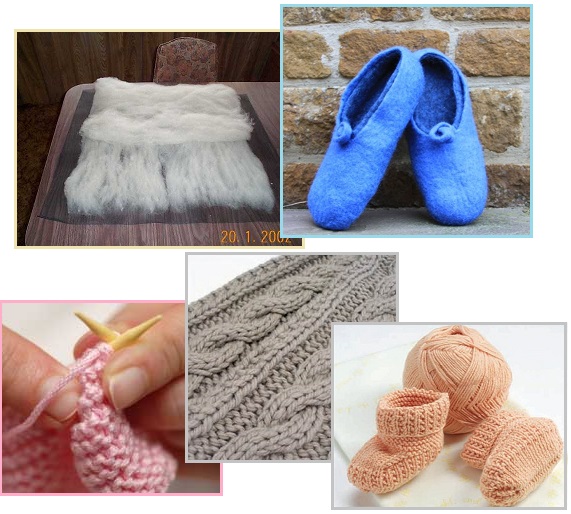
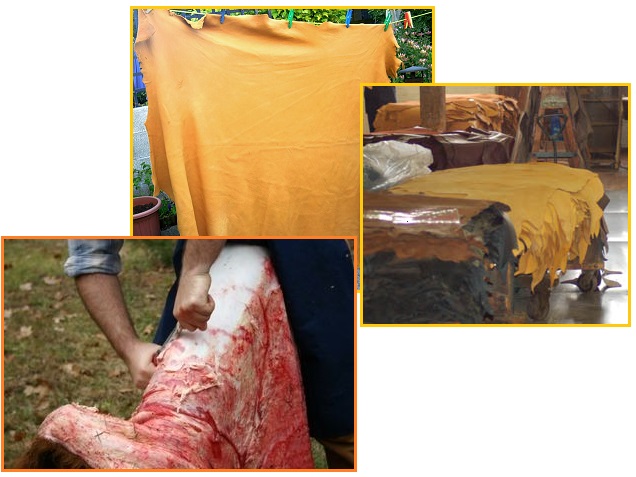
Making Clothing Since wool tightens and shrinks when heated, a type of cloth called felt can be made from small scraps. The felting process is to lay wool fibers in different directions, then pour boiling water over the lot. Felt is durable and wet felt can be formed into slippers. After being spun into yarn, fibers such as wool can be knitted into garments using a pair of knitting needles or crocheted via a crochet hook. Transforming natural materials into clothing in this way has been done by idle hands in the evenings around the fire for centuries. Curing leather to be used in coats or shoes or chaps is messy at first, because the leather must be scraped clean. There are many chemicals used for curing leather, but one survivors are almost certain to be able to obtain is the time-honored tannin from the bark of many different trees. Some rivers even owe their dark brown color not to mud but tannin from trees upstream. That’s the case for the Baraboo River that flows past my house here in Wisconsin, for instance. Soaking the leather in a mash from the brains of the animal is another tanning technique.
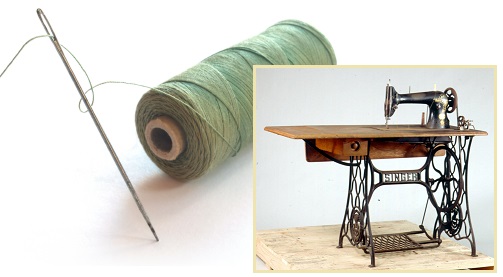
Most cloth is woven on looms from threads and wool spun into a fine twist. But leather is just cut into the appropriately sized pieces. Regardless of whether knitted, woven, or from pieces of leather, cloth requires needle and thread at some point. This is for stitching by hand, or by machine. In the future, when electricity might not be available, a treadle sewing machine is just the thing. They can be found at yard sales, in barns or antique stores, for sale on eBay, and even manufactured new these days. If shopping at the mall becomes impossible, and your existing
clothing supplies are getting raggy, get or make a spinning
wheel and a loom to make cloth, blankets, or knitted
clothing items such as scarves and sweaters. As the Zetas have
stated, needle and thread will be worth more than Gold and
Silver in the Aftertime. It was not so long ago that making
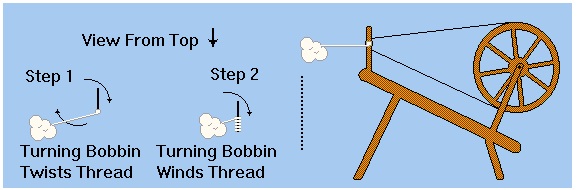
thread and yarn and making new clothes was the norm. There is a groove in the wheel that holds a cord, and a similar
groove in a tiny wheel on the other end of the Spinning Wheel.
The relatively slow motion of the large wheel thus makes for
many turns of the tiny wheel, which is attached to the bobbin.
This bobbin replaces the more primitive spindle. Enough tension
is placed on the cord wrapped around the wheel and thence to the
bobbin so that the cord does not readily slip on either the
wheel or the bobbin. The knot in the cord should be as smooth as
possible. The warp is strung by winding a continuous thread around pegs on a warp frame. Wind the thread back and forth several times, creating several warp threads at one time, and then grip the bunch on both ends and transfer the warp lengths to the loom frame. This is done repeatedly until the warp is as wide as the loom or as wide as desired. Make the warp as long as possible, as the very front and back of the warp can never be woven and become waste or fringe. The warp threads on the loom are threaded through heddles, which are also made of string or thread. A heddle is in essence a small string loop inside a larger string loop, with the small loop in the middle to hold a warp thread so it can be raised or lowered during the weaving process. The heddles are made on a heddle frame composed of three nails on a board, the top loop tied above the middle nail, then below the middle nail, then below the bottom nail. |
|||||||||

 \
\ 